基础知识篇
基础知识
句型句式
- Statement陈述
- 说明事实与态度
- Question疑问
- 提出问题请对方回答
- Command祈使
- 发出指令、要求、劝告
- Exclamation感叹
- 强烈抒发内心情感或喜怒哀乐
陈述句
- 功能
- 说明客观事实
- The stone will roll down the mountain by gravity.
- The year of 2018 marks the 40th anniversary of the reform and opening-up policy in China.
- 表达自己的观点
- March is my favorite month when cherry blossom is in full bloom.
- A successful relationship is basically about having courage and sincerity.
- 说明客观事实
- 分类
- 肯定陈述
- Christmas season is a time full of traditions.
- People in UK drink an average of 1.94kg of tea every year.
- 否定陈述,带有否定词not
- Translation should not be too rigid or excessive.
- 肯定陈述
- 表达情感态度的“强调”和“削弱”
- 削弱:I’m afraid,I suppose, I suspect, if I am not mistaken等,削弱说话人的语气,变得更加委婉。
- If I am not mistaken, I think you come from Sweden.
- I suspect that she is ill,but I’m not sure.
- 增强:actually,certainly,really,definitely,without doubt,on no account(绝不),not a single(一个也没有)
- On no account can we ignore the value of knowledge.
- Certainly nobody could be expected to memorize every detail.
- 削弱:I’m afraid,I suppose, I suspect, if I am not mistaken等,削弱说话人的语气,变得更加委婉。
- 翻译练习
- 我想你是对的
- 毫无疑问,健康是人们最关系的问题
- 一百次的尝试中,一次也没有失误(百无一失)
- 放心,我肯定会跟那个客户确定具体的发货时间
I suppose you are right.
Without doubt,health is people’s top concern.
There is not a single miss in a hundred tries.
Rest assured, I’m definitely going to confirm the specific delivery time with that client.
疑问句
- 分类
- 一般疑问句,询问事情是否属实,将句子中的be动词、助动词、情态动词提到最前面,用yes/no回答,又称“是非问句”。
- Is it about to crash?(Yes,it is./No,it isn’t.)
- 是不是要破产了?
- Has she responded to your letter?(Yes,she has./No,she hasn’t .)
- 她有没有回复你的信?
- Can you point out the man you suspect?(Yes,i can./No,I can’t.)
- 你能把你怀疑的人指出来么?
- Did you reflect on the consequences of your behavior?(Yes.I did./No,I didn’t.)
- 你考虑过你的行为的后果吗?
- Is it about to crash?(Yes,it is./No,it isn’t.)
- 特殊疑问句,由疑问词(疑问代词who,which,whose,what和疑问副词when,where,why,how等)构成,又称“wh-问句”。
- What does he mean by cancelling his performance?
- 他取消他的表演是什么意思?
- Why is there so much noise coming from this classroom?
- 为什么这个教室传来这么大的噪音?
- What does he mean by cancelling his performance?
- 选择疑问句—“一般疑问句”构成,选项用or连接
- Did you fly to New York or (**did you )**go there by sea?
- 你去纽约是坐飞机还是乘船?
- **Is it **round,square,or triangular?
- 它是圆的,正方形的,还是三角形的?
- Did you fly to New York or (**did you )**go there by sea?
- 选择疑问句—“特殊疑问句”构成,选项用or连接
- How shall we go to New York,by plane or by sea?
- 我们怎么去纽约,坐飞机还是乘船?
- Which do you like better,laptop or desktop?
- 笔记本电脑和台式机,你更喜欢哪一个?
- How shall we go to New York,by plane or by sea?
- 附加疑问句,由“陈述句+附加问句”构成,附加问句的动词、主语根陈述句的动词、主语相对应。
- The watch is 20 minutes fast, isn’t is?
- 手表快了20分钟,不是吗?
- Your younger brother can swim,**can’t **he?
- 你弟弟会游泳,不是吗?
- 附加疑问句注意事项
- 陈述句主语表示人的不定代词(everybody,everyone,someone,no one等)附加主语可使用he(侧重个体,正式)/they(侧重整体,非正式)。
- Everyone knows the solution to the research,doesn’t he?/don’t they?
- No one was absent from this meeting,was it?/were they?
- 陈述句主语是表示物的不定代词(everything,anything,something,nothing等)时,附加问句主语用it。
- Everything is ready,isn’t it?
- Nothing could stop my yearning for freedom,could it?
- 陈述句主语为不定代词one,附加问句主语用one/you。
- One should be responsible ,shouldn’t one/you?
- One shouldn’t hold a negative attitude towards life,should one/you?
- 陈述句主语为指示代词this/that,附加主语it,陈述句主语为指示代词these/those,附加主语为they
- This is an excellent time to go outing,**isn’t it? **
- Those are courses designed for kids under the age of four,aren’t they?
- 主现存句(there be句型),附加句主语仍用there
- There is one problem with this approach,isn’t there?
- There are report of widespread dissatisfaction in the club,aren’t there?
- 陈述句为I am ,附加句aren’t I
- I am late, aren’t I?
- To a certain extent,I am responsible for the delay,aren’t I?
- 陈述句有否定词(no one,nothing,never,seldom,hardly,few,little等),附加句使用肯定
- Lily seldom smiles in her daily life,does she?
- There is little I can help you,is there?
- 陈述句主语表示人的不定代词(everybody,everyone,someone,no one等)附加主语可使用he(侧重个体,正式)/they(侧重整体,非正式)。
- The watch is 20 minutes fast, isn’t is?
- 一般疑问句,询问事情是否属实,将句子中的be动词、助动词、情态动词提到最前面,用yes/no回答,又称“是非问句”。
确定附加问句方法
- 确定主语
- 确定动词
- 确定是否定还是肯定附加句
加强疑问句语气的方法:
在疑问词后加上ever,on earth, in the world, the goodness, in heaven’s name等可以加强疑问句的语气,可翻译为“究竟/到底”。
What in heaven’s name are you taking about?
你到底在说什么?
How ever do you find the time to learn cooking?
你究竟怎么挤出时间来学习烹饪的?
Mary’s dictionary was lost on the street yesterday.
改为疑问句形式
- Was Mary’s dictionary lost on the street yesterday?
2.What was lost on the street yesterday?
3.Who was lost a dictionary on the street yesterday?- Whose dictionary was lost on the street yesterday?
5.Where was Mary’s dictionary lost yesterday?
6.When was Mary’s dictionary lost on the street?
7.Why was Mary’s dictionary lost on the street yesterday?
8.Which dictionary was lost on the street yesterday,Chinese or Japanese?
祈使句
- 定义、分类与构成
- 祈使句是说话者发出指令、要求、劝告等的句子,分为第一人称、第二人称、第三人称祈使句
- 第一人称:Let’s do
- 第二人称:(You) do/(You) let us do/(You) let me do
- 第三人称:Let him/her/them/it do
- 祈使句是说话者发出指令、要求、劝告等的句子,分为第一人称、第二人称、第三人称祈使句
- 祈使句的否定
- 句子前加don’t/never
- Don’t make a fuss about trifles.
- Don’t leave her waiting outside in the rain.
- Never place the milk out in the sun or it will turn bad.
- Never forget to be thankful to those who have helped you.
- 句子前加don’t/never
- 祈使句语气的加强
- 在句首加重读的do,使语气强硬
- Do be careful with those fireworks!The slightest spark could set them off!
- Do let me know if there is anything i can do for you.
- 在句首、句中、句尾使用呼语,强调命令向谁发出
- Don’t anybody hit the panic button!
- 别让任何人按紧急按钮!(任何人都不要紧张!)
- Stop talking in such a disrespectful way,Jim!.
- Everyone be quite now,and our show will begin soon!
- Don’t anybody hit the panic button!
- 在句首加重读的do,使语气强硬
- 祈使句语气的削弱
- 在句首或句尾加please,使语气更加委婉
- A bottle of wine and two plates of beef,please.
- Please be seated,ladies and gentlemen.
- 在祈使句后添加附加问句,此时,整句话变为“附加疑问句”
- **Let’s **go camping,shall we?
- Let us go now,will you?
- 现在(你)让我们走吧,好吗?
- Don’t make any noise,will you?
- Help me with this mathematical problem,will/won’t you?
- 在句首或句尾加please,使语气更加委婉
祈使句的附加问句
- 第二人称肯定祈使句,加will you 或 won’t you
- 第二人称否定祈使句,加will you
- Let’s开头的祈使句,加shall we
- Let us开头的祈使句,加will you
第一人称祈使句:
Let’s avoid unrealistic expectations.(让我们避免不切实际的期望)
第二人称祈使句:
Let me think what to do next.((你)让我想想接下来干什么)
Open your book and turn to page eleven.((你)打开书本)
Show the foreign guests around the factory.((你)带外宾)
Let us have a look at the theory first.(请(你)让我们先看下理论)
第三人称祈使句:
Let bygones be bygones.(既往不咎)
Let boys be boys.(男孩就要有男孩的样子)
感叹句
- What引导的感叹句构成
- What+a/an+形容词+可数名词单数(+主语+谓语)!
- What+形容词+可数名词复数(+主语+谓语)!
- What+形容词+不可数名词(+主语+谓语)!
What a capable manager(he is)!
What inspiring stories(these are)!
What fresh air(it is)!
- How
- How+形容词/副词+主语+谓语+其他!
- How+主语+谓语!
How glorious the day will be!
How quickly a rash thing is done!
How diligently he prepares for Graduate Management Admissions Test!
- 其他形式
- 使用单词表感叹
- Splendid!
- 使用词组表感叹
- Good job!
- 使用陈述句表感叹
- He is so hardworking!
- 使用疑问句表感叹
- Aren’t these roses beautiful?
- 使用祈使句表感叹
- Many happy returns of the day!
- (生日用词)遐龄永享,康宁如注!
- Many happy returns of the day!
- 使用单词表感叹
这些花多美丽啊!
What beautiful flowers there are!
今天天气真好啊!
what fine weather it is today!
这些山多高啊!
How high the mountains are!
在这样一个凉爽的下午打篮球是多么令人兴奋!
How exciting it is to play basketball on such a cool afternoon!
句子成分
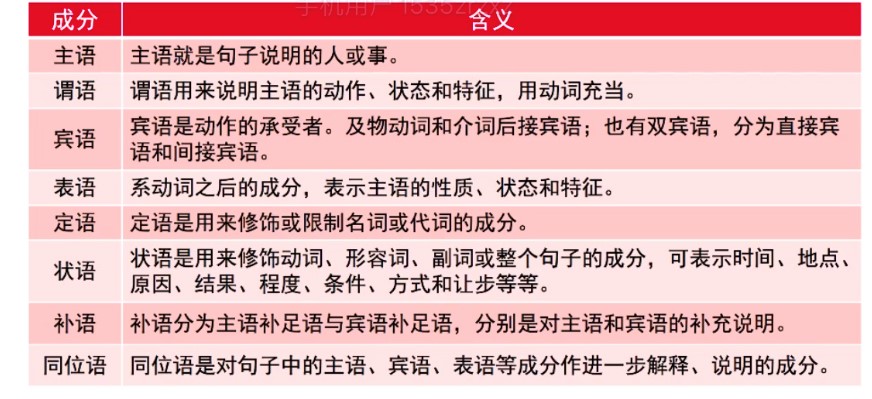
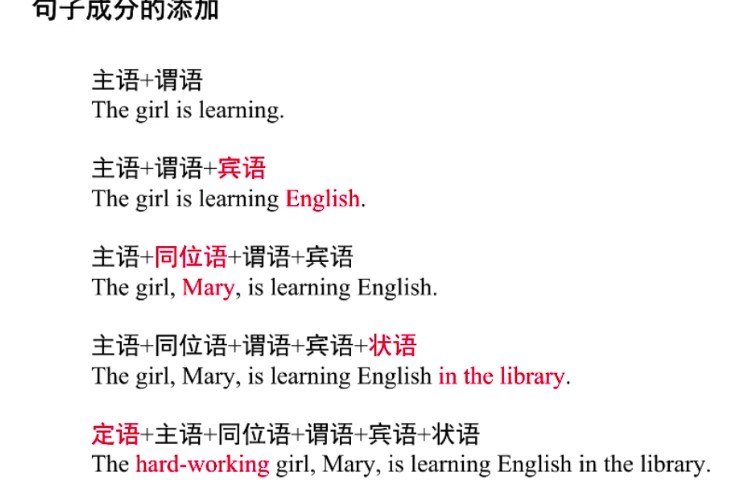
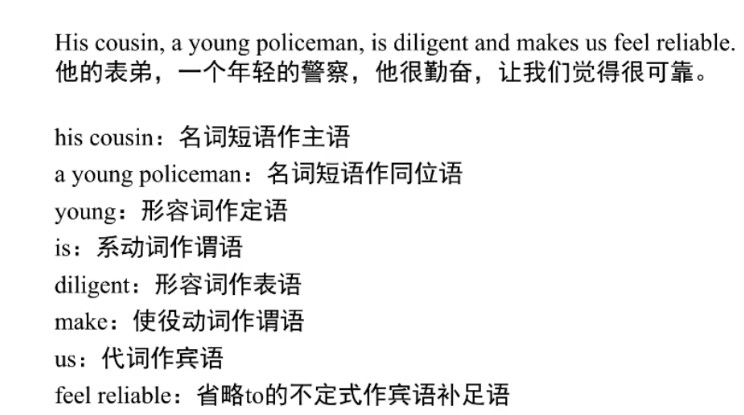
包括主语、谓语、宾语、表语、定语、状语、补语和同位语。
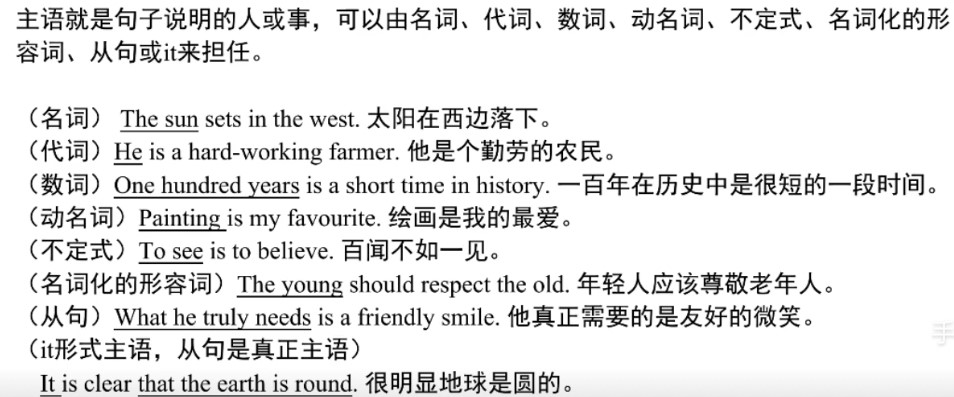
可以充当主语的词
可以充当谓语的词
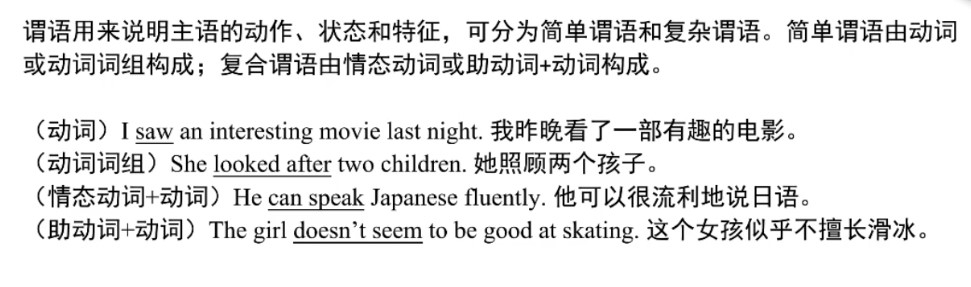
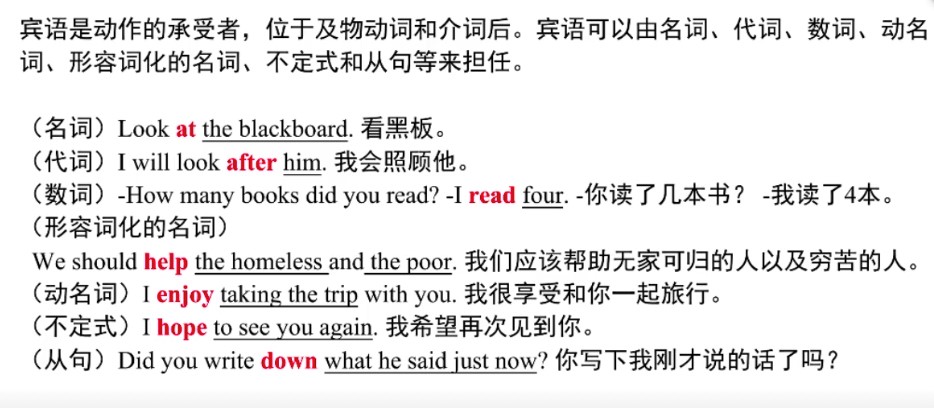
可以充当宾语的词
- at/after等介词后的词可以充当宾语
- 及物动词后的词
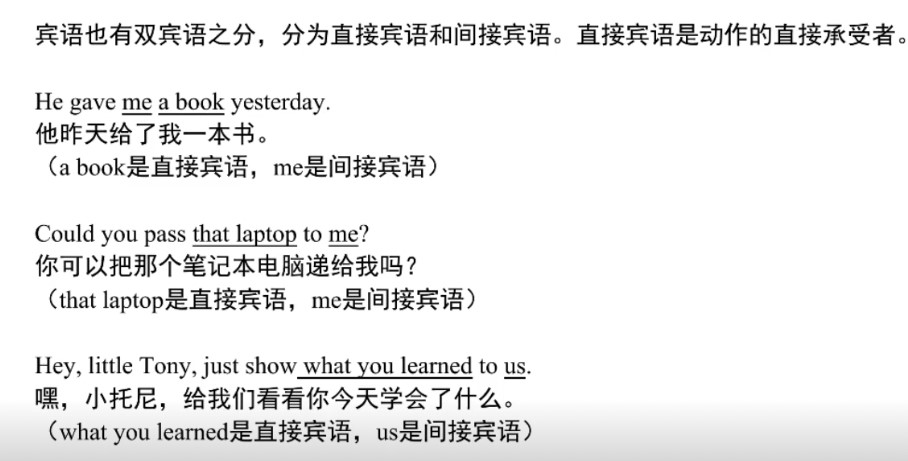
注意区分直接宾语和间接宾语
可以充当表语的词
系动词后的成分
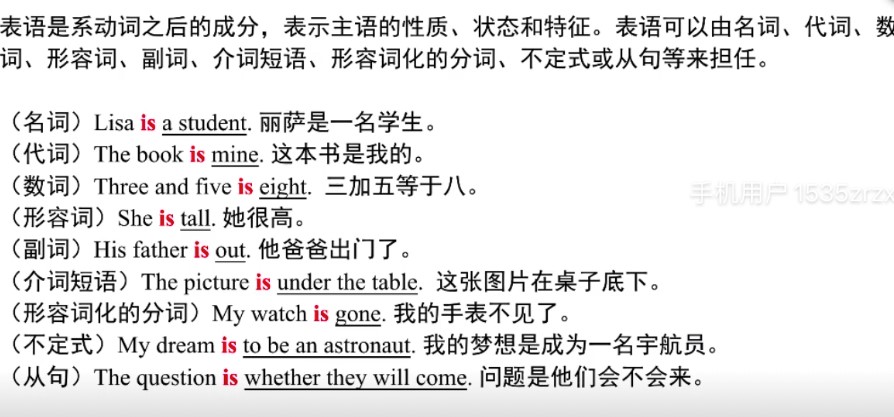
分析划线部分成分
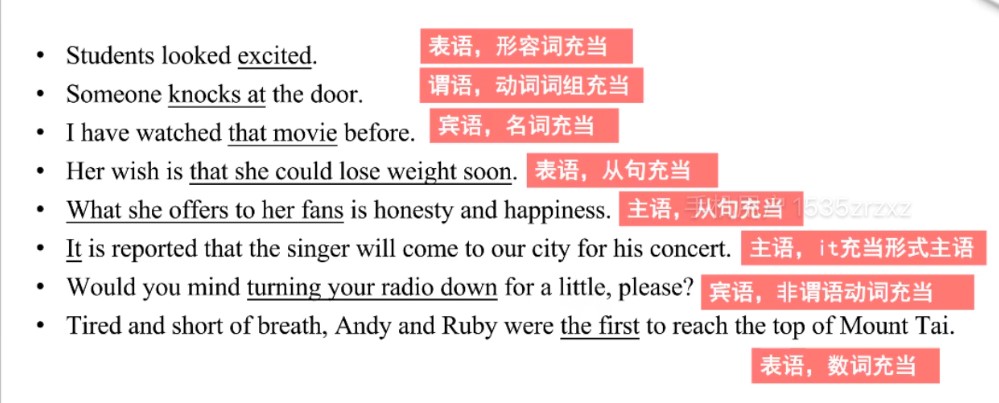
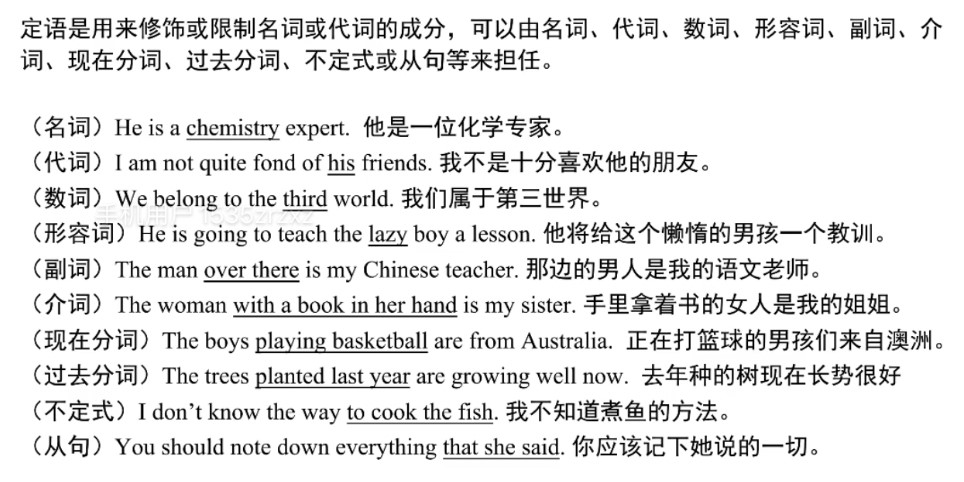
可以充当定语的词
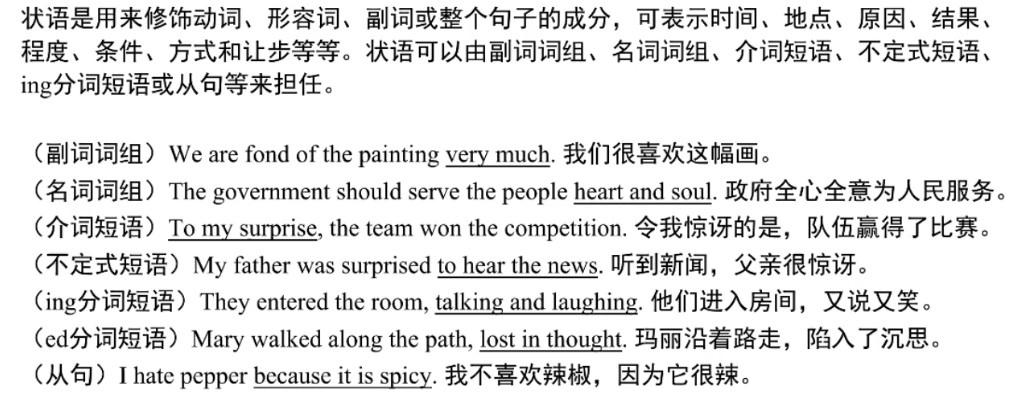
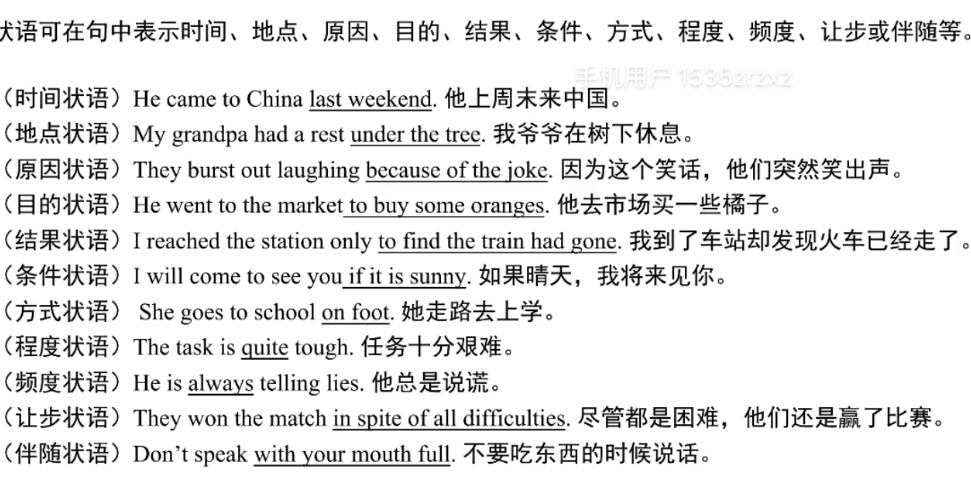
可以充当状语的词
修饰/表状态
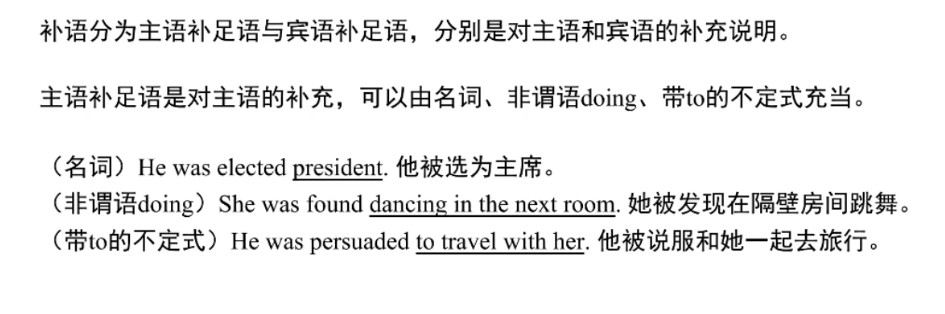
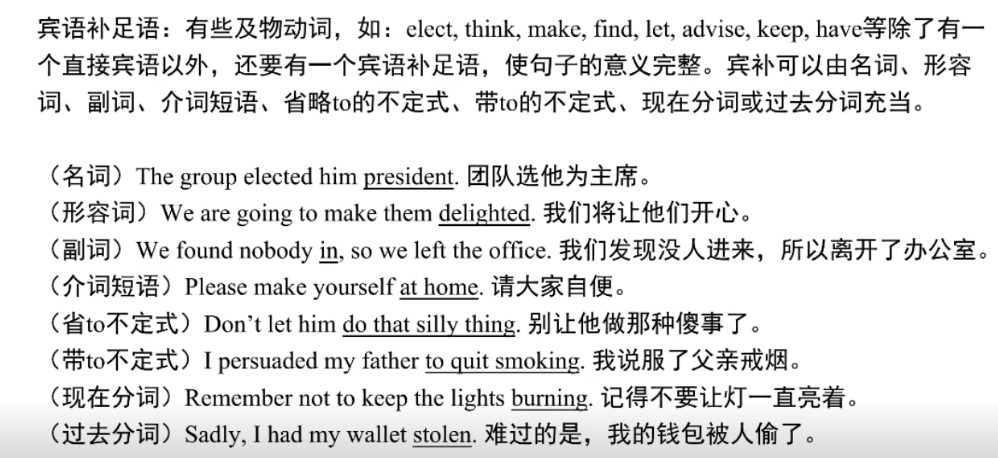
可以充当补语的词
主语补足语/宾语补足语
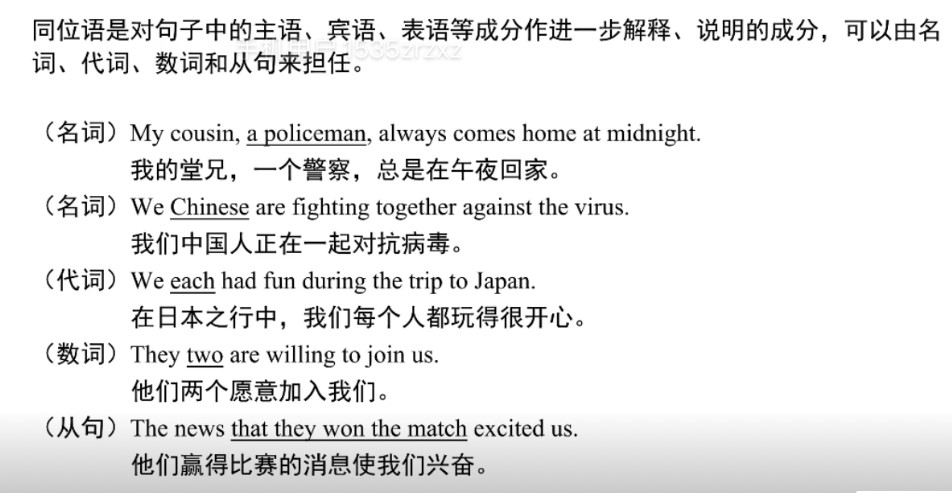
可以充当同位语的词
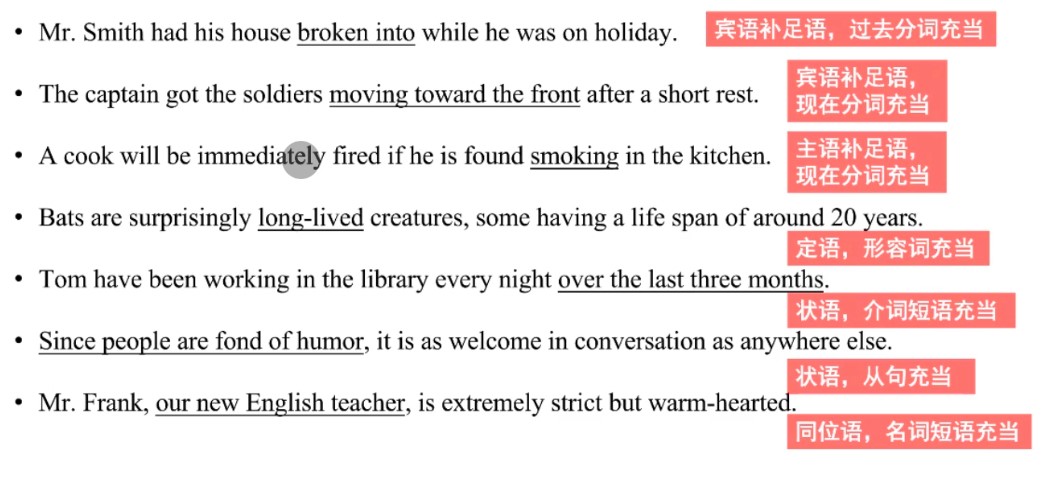
分析句子成分
句子结构
句子结构成分的缩写
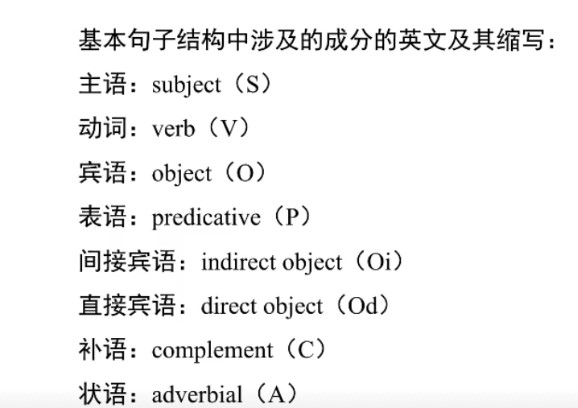
基本句式结构
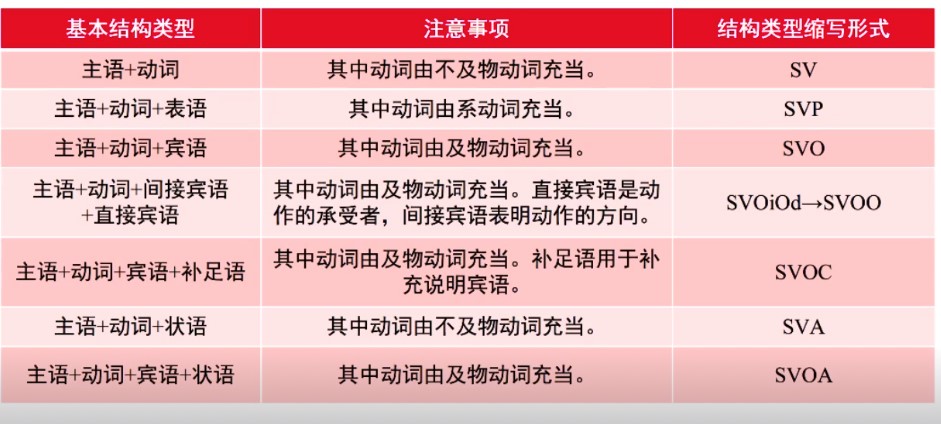
分析句子类型
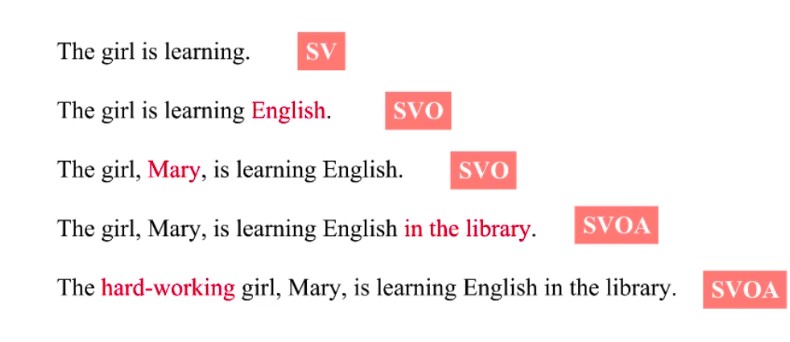
- SV基本句型
- SVP基本句型
- SVO基本句型
- SVOO基本句型
- 分析长句句子类型
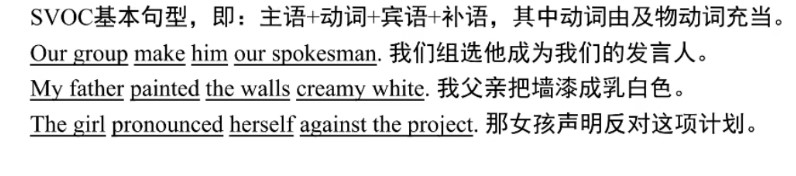
- SVOC基本句型
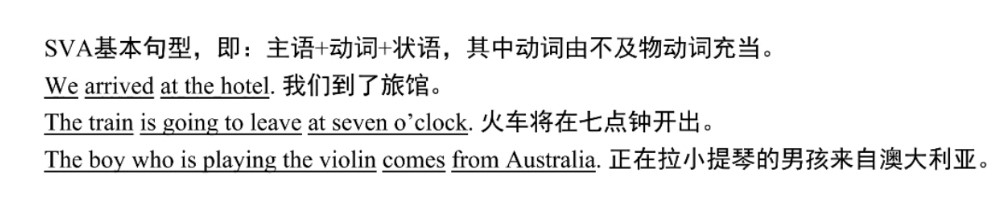
- SVA基本句型
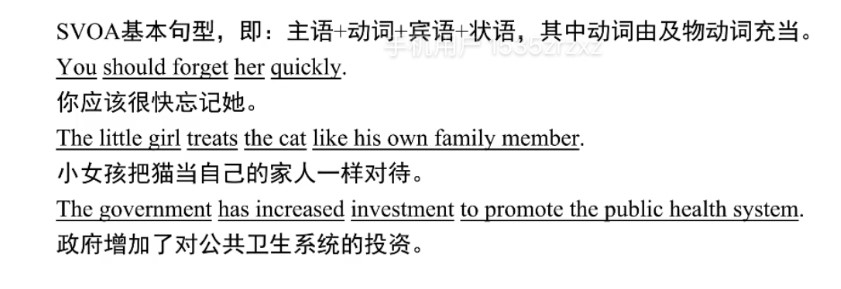
- SVOA基本句型
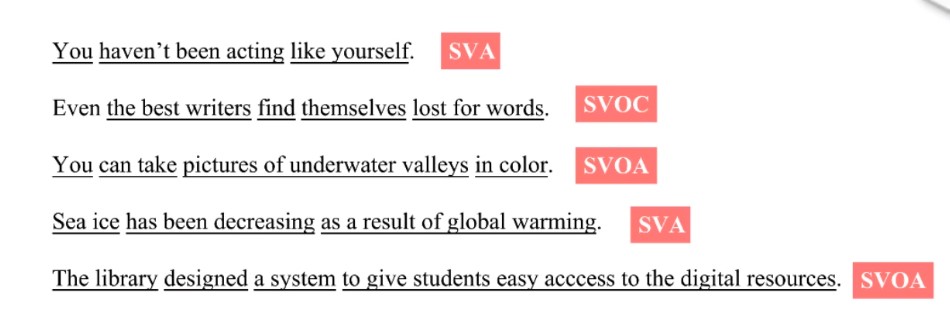
- 分析长句类型
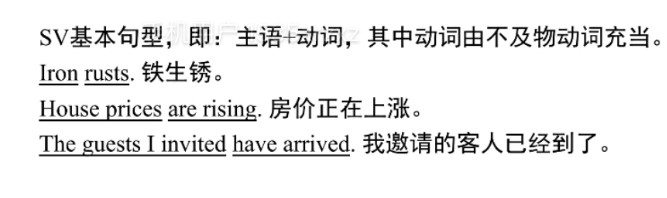
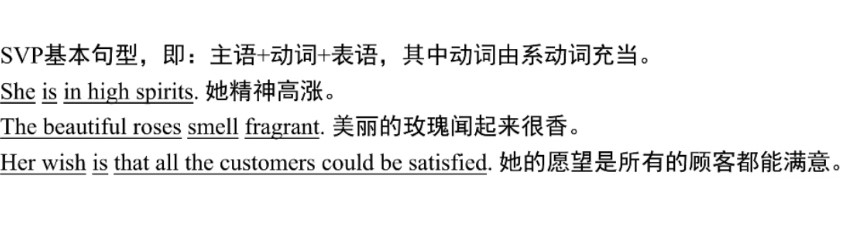
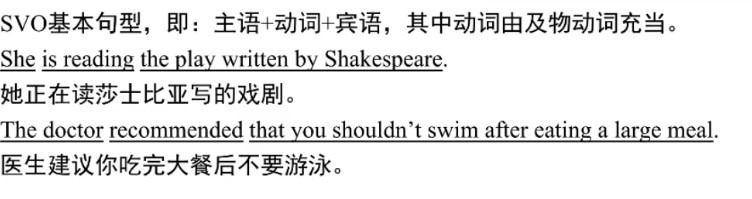
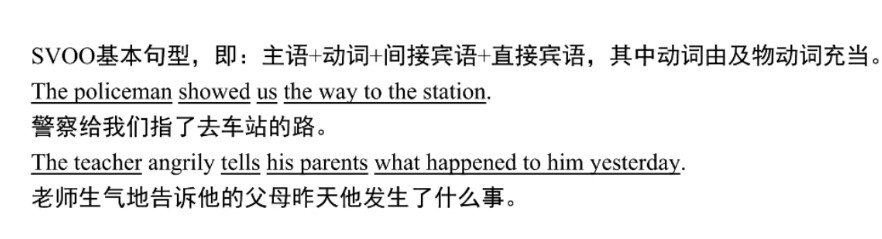
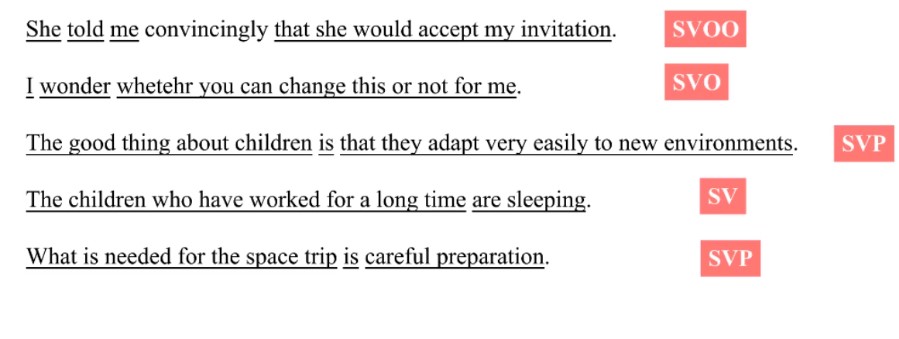
词形的句法功能
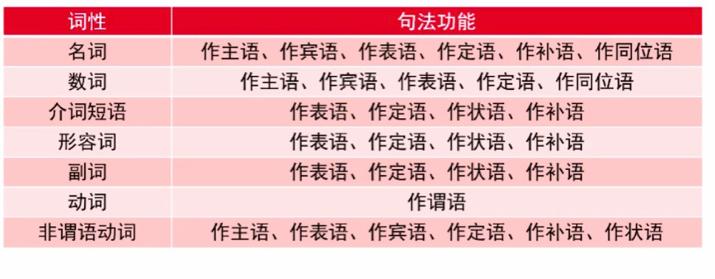
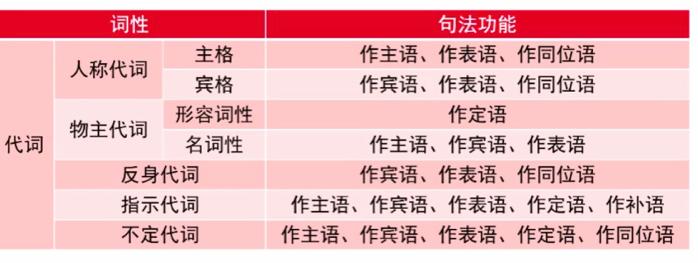
名词
- 名词充当主语。
- Self-confidence is the mainstay of a strong character.(自信是强者之脊梁。)
- The lawyer is going to undertake this tough case.(律师将会接受这个棘手的案子。)
- 名词充当宾语。
- He braked his car just in time to avoid an accident.(他及时刹车,避免了一次事故。)
- They preferred not to talk about this question at the time.(在这个时刻,他们宁愿不谈这个问题。)
- 名词充当表语。
- Tom turned teacher, which he didn’t wish to be.(汤姆成了教师,可那不是他所希望的。)
- What is missing from a lot of lives is romance.(生活中大量缺少的就是浪漫色彩。)
- 名词充当定语。
- The woman received a diamond necklace as a gift.(那女人收到一条钻石项链作为礼物。)
- Is that chemistry teacher strict or easy-going?(那位化学老师很严厉还是很好相处?)
- 名词充当补语。
- He was elected president of the association.(他被选为协会主席。)
- The strikers constituted him their spokesman.(罢工者任命他为他们的发言人。)
- 名词充当同位语。
- We Chinese have the spirit to fight the enemy to the last drop of our blood.(我们中华民族有同自己的敌人血战到底的气概。)
- Miss Ma, our gcography teacher, is highly respected by all.(马老师,我们的地理老师,极受大家的尊敬。)
- Can you tell us your ( ) for happiness and a long life?
- Living every day to the full, definitely.
A. гесіре
B. record
C. reception
D. receipt
【答案】A
【翻译】一您能告诉我们您幸福与长寿的秘快吗?—确切地说,是充实地过好每一天。
根据答语可知,此处问的是幸福与长寿的秘诀。recipe秘诀,決窍,符合句意。record记录;reception接待处;receipt收据,均不符合题意。
【成分】recipe作直接宾语。
We can observe that artificial intelligence has already made a(an).( )on our lives in many ways.
A. statement
B. impact
C. impression
D. judgment
【答案】B
【翻译】我们能够注意到,人工智能在很多方 面已对我们的生活产生了影响。make astatement发表声明;make an impact on对..产生影响;make an impression on给.留下印象;make a judgment作出判断。结合句意可知,应选B。
【成分】impact作宾语。The failure was a big ( )to him, but he wasn’t discouraged and soon got as enthusiastic as ever.
A. blow
B. issue
C. excuse
D. factor
【答案】A
【翻译】这次失败对他来说是一次很大的打击,但他没有泄气,很快就变得和以往一样充满热情。blow打击,符合句意。issue问题,议题;excuse借口;factor因素。
【成分】blow作表语。When he was running after his brother, the boy lost his( ) and had a bad fall
A. balance
B. chance
C. memory
D. ability
【答案】A
【翻译】当这个男孩追赶哥哥的时候,他失去了平衡,狠狠地摔了一跤。根据句中的 had a bad fall可知,这个男孩之所以摔倒是因为失去了平衡,lose one’s balance意为“失去平衡”。chance机会;memory记忆;ability能力。
【成分】balance作宾语。
数词
- 数词充当主语。
- Eight minus three is five.(八减三得五。)
- “The third is a blanket without any thread.” said Mary, looking at the gifis.(“第三件是没有线的毯子,”玛丽看着礼物说道。)
- 数词充当宾语。
- Personally speaking, I prefer the second to the third.(就我个人而言,比起第三个,我更喜欢第二个。)
- How many candles do you need? -I need thirty.(你需要多少支蜡烛?-我需要三十支。)
- 数词充当表语。
- The zip code is 83232.(邮政编码是83232.)
- We were the first to congratulate the bride and groom.(我们是最先向新娘和新郎祝贺的。)
- 数词充当定语。
- Attention, please! The bus will leave in ten minutes.(请注意!公共汽车十分钟后开。)
- The second option is technically superior but it demands higher-performance equipment.(第2种选择具有技术优越性,但需要高性能的设备。)
- 数词充当同位语。一般在主格代词之后
- They two are on intimate terms.(他们俩很亲近。)
- We four affectionately watched his back as he stood in the bows looking to scaward.(当他站在船头向海上望去时,我们四个人都热切地朝着他的背影看着。)
- They three get along well with one another; one is married, another is still a bachelor, and the other has a girl friend.(他们三人彼此相处愉快;一个已婚,一个仍是光棍,而另一个已有了女友。)
翻译对话
- 第二个是你的。
The second is yours. 作主语- 他的父亲今年58岁。
His father is fifty-eight this year. 作表语- 他有三本英汉宇典。
He has three English-Chinese dictionaries. 作定语- 让我们四个人完成这项工作,好吗?
Let us four finish the work, will you?作同位语.
介词短语
- 介词短语充当表语。
- Health is above wealth.(健康高于财富。)
- His clinic is near the newlv-built railway station.(他的诊所在新建的火车站附近。)
- 介词短语充当定语。
- The lady in the car is from France.(车上的那位女士来自法国。)
- The man in black is Mr. Brown, our literature teacher.(穿黑衣服的人是布朗先生,我们的文学老师。)
- 介词短语充当状语。
- Did you do this by design or by accident?(你这样做是有意的还是无意的?)
- You are getting better at eating with chopsticks!(你越来越擅长用筷子吃饭了!)
- 介词短语充当补语。
- I found everything in good condition.(我发现一切正常。)
- She pronounced herself against the contract.(她声明反对合同。)
Favorable policies are ( ) to encourage employees’ professional development.
A. in effect
B. in command
C. in turn
D. in shape
【答案】A
【翻译】优惠政策会有效地促进员工的职业发展。in effect有效;in command应付自如;in tum逐一、轮流;in shape..的模样。
【成分】in effect作表语“What a terrible rain we are having!” - “Yes. We are asked to pay more attention to the information about the rain ( )flood”.
A. as well as
B. so long as
C. because of
D. in case of
【答案】D
【翻译】-“我们马上迎来一场可怕的大雨!“是的。我们被要求更加关注有关这次的降雨以防洪水。”in case of 有两个意思,一表示条件,意为“如果”;二表示目的,意为“以防”。
【成分】in case of作状语The Scottish girl ( )blue eyes won the first prize in the Fifth Chinese Speech Contest.
A. By
B. of
C. in
D. with
【答案】D
【翻译】在第五届汉语演讲比赛中,那位蓝眼睛的苏格兰女孩赢得了第一名。所填词介词意思是“有”,用with。
【成分】with blue eyes作定语My sister was against my suggestion while my brother was
( ) it.A. in favour of
B. in memory of
C. in honour of
D. in search of
【答案】A
【翻译】我姐姐反对我的建议而我的弟弟支持。in favor or支持;in memory of纪念,追念;ihonour of为纪念,为庆祝;in scarch of搜寻,探求。
【成分】in favour of作表语
形容词
- 形容词充当表语。
- He was petrified with terror.(他吓得发呆。)
- This may seem impossible, but it is not unprecedented.(这似乎不太实际,但并不是没有先例。)
- 形容词充当定语。
- Mental models become deeply ingrained as a result of previous experiences.(由于以前的经历,心理模型变得根深蒂固。)
- Accompanied by cheerful music, we began to dance.(伴随着欢乐的音乐,我们跳起舞来。)
- 形容词充当状语。
- Anxious about her son’s safety, she called him many times.((因为)担心她儿子的安全,她打了好几次电话给他。)(形容词作原因状语)
- He was coincidentally locked in the dark house, worried and frightened.(他碰巧被锁在黑暗的房子里,既担心又害怕。)(形容词作伴随状语)
- 形容词充当补语。
- I think we should leave the door open. It is too hot indoors.(我觉得我们应该把大门开着,室内太热了。)
- What I said just now will probably make some people angry.(我刚才说的话可能会让一些人生气。)
His comprehensive surveys have provided the most ( )statements of how, and on what basis,data are collected.
A. explicit
B. ambiguous
C. original
D. arbitrary
【答案】A
【翻译】他全面的调查提供了关于如何收集信息,以及在什么基础上收集信息的最清楚明确的说明。explicit清楚的,明晰的;ambiguous模棱两可的;original起初的;arbitrary任意的。
【成分】explicit作定语。Several hours later, with the help of the police, the tourists manage to escape from the dangerous place,( )
A. hungry and scaring
B. hungrily and scared
C. hungry and scared
D. hungrily and scaring
【答案】C
【翻译】几个小时后,在警察的帮助下,游客设法从危险的地方逃了出来,感到又饿又怕。
【成分】hungry和scared作状语表伴随,位于句首或句末,用逗号隔开。You shouldn’t have said that. Look! She is getting ( )
But I meant no harm.
A. unfair
B. unconcerned
C. unmoved
D. uneasy
【答案】D
【翻译】-你不该那么说。你看,她变得非常不安了。-但我没有恶意啊。unfair不公平的;unconcerned不关心的;unmoved冷漠的;uneasy不安的。
【成分】uneasy作表语。4.In this article, your content is too general and you need to make it ( )
A. specific
B. permanent
C. abstract
D. universal
【答案】A
【翻译】在本文中,你的内容过于笼统,需要使其具体化。specific具体的;permament永久的;
abstract抽象的;universal通用的,普遍的。
【成分】specific作补语。
副词
- 副词充当表语。一般是表示地点的副词,或与介词同形的副词。
- My temperature is down, but I am still feeling weak.(我烧是退了,可身上还是没劲儿。)
- He suddenly realizes that their romance is over.(他突然意识到他们的浪漫史结束了。)
- 副词充当定语。一般是表示地点、时间的副词。
- It is hoped that you will give due attention to all the points above.(希望您对以上的各个要点给子应有的重视。)
- The temperature today is two degrees higher than yesterday.(今天的气温比昨天高两度。)
- 副词充当状语。
- She was reckoned very intelligent.(她被认为很聪明。)
- Though the app may be useful at times, most users do not frequently use it.(尽管这个程序偶尔会有用,但多数用户不会经常使用它。)
- 副词充当补语。一般是表示地点的副词。
- The girl was found upstairs, alone.(女孩被发现在楼上,独自一人。)
- Unfortunately, I didn’t see anybody in, so I left.(真不湊巧,我没看到任何人进来,所以我离开了。)
They gave money to the old people’s home either ( ) or through their companies.
A. legally
B. sincerely
C. personally
D. deliberately
【答案】C
【翻译】他们或亲自或通过他们的公司给敬老院送钱。legally合法地,法律上;sincerely真诚地;personally亲自,就自己而言;deliberately故意地,谨慎地。根据through their companies可知选择personally。
【成分】personally作方式状语。Time is ( ) .Let’s continue our seminar after a short tea break.
A. out
B. in
D. up
C. away
【答案】D
【翻译】时间到了,让我们在短暂的茶歇过后继续我们的研讨会。根据句意选择D,Time is up.
是固定用法,意为“时间到了”。
【成分】up作表语。I am wondering if Professor C is in the office or not.
I saw him ( )half an hour ago. I guess he will be back soon.
A. in
B. out
C. over
D. around
【答案】B
【翻译】-我想知道C教授是否在办公室。-半小时前我看见他出去了。我想他很快就会回来。符合句意的只有B选项。
【成分】out作补语。The wardrobe to be repair ( ) is really heavy. I think we need three people to move it down.
A.upstair
B.downstairs
C.upstairs
D.downstairs
【答案】C
【翻译】楼上要修的衣柜真的很重。我想我们需要三个人把它搬下来。A和B为形容词,C和D为副词。根据move it down可知“衣柜在楼上”,选择upstairs。
【成分】 upstairs作定语。
动词
- “实义动词”单独作谓语。
- I can’t perceive any differences between these paintings.(我看不出这些画有什么不同。)
- I fasten these papers with a paper clip.(我用回形针把这些试卷固定好。)
- “动词短语”作谓语。
- They make use of advertisements to promote the new product.(他们利用广告推销新产品。)
- If you come across a word whose meaning you have forgotten, consult the dictionary.(如果你遇到一个你忘了意思的词,请查宇典。)
- “情态动词+动词原形”作谓语。
- All of us shall observe the code of practice.(我们大家都应遵守业务守则。)
- I will not deny that she was delighted after hearing such flattery.(我不否认她听到这样的奉承后感到高兴。)
- “助动词+动词的变化形式,作谓语。动词变化形式包括:原形、现在分词、过去分词。
- He was beaten black and blue.(他被打得鼻青脸肿。)
- She is laughing heartily because of the jokes her boy friend told just now.(因为他男朋友刚说的笑话,她正开怀大笑。)
Last week a tennis ball hit me on the head, but I tried to ( ) the pain, believing that it would go away sooner or later.
A. isolate
B. interrupt
C. ignore
D.intend
【答案】C
【翻译】上周一个网球打到了我的头上,但我试着无视疼痛,相信它迟早会消失的。
isolate隔离;interrupt打断;ignore忽视;intend打算。It is widely believed that students should be ( )in terms of overall quality.
A. supported
B. surrounded
C. evaluated
D. excluded
【答案】C
【翻译】人们普遍认为,应该从綜合素质的角度来评价学生。support支持;SurTound包围;
evaluate评价;exclude排除。Nowadays, more and more wind power stations are ()to meet the demand for clean energy.
A. taking up
B. clearing up
C. holding up
D. springing up
【答索】D
【翻译】如今,越来越多的风力发电站正在兴起,满足人们对清洁能源的需求。take up从事,占据;clear up清理;hold up举起,阻碍;spring up突然兴起。Tom kept silent during the early part of the seminar but he eventually( )his opinion on the theme.
A. gave voice to
B. kept an eye on
C. turned a deaf ear to
D. set foot on
【答案】A
【翻译】汤姆在研讨会的初期保持沉默,但他最终就这个主题发表了他的意见。give voice to
表达对…的想法;keep an eye on留意;turn a deaf car to对..充耳不闻;set foot on踏上,登上。
非谓语
- 非谓语动词充当主语。
- To complete this assignment is quite difficult. (to do不定式)(完成这项任务相当困难。)
- Setting your watch three minutes ahead is an effective way to avoid being late. (doing动名词)(把表提前三分钟是避免迟到的有效方法。)
- 非谓语动词充当宾语。
- I decided to study English language in college. (to do不定式)(我决定在大学里学习英语。)
- He was in low spirits and even considered going away. (doing动名词)(他情绪低落,甚至考虑离开。)
- 非谓语动词充当表语。
- The current situation in our country is encouraging. (doing现在分词)(我国目前的形势令人鼓舞。)
- The next step is to make sure that you know what is needed. (to do不定式)(下一步是确保你知道需要什么。)
- Her mother was pleased that shc chose a college close to home. (done过去分词)(她母亲很高兴她选择了一所离家近的大学。)
- The duty of our organization is serving our customers heart and soul. (doing动名词)(我们組织的职责是全心全意为客户服务。)
- 非谓语动词充当定语。
- The desire to love and to be loved is universal. (to do不定式)(对爱和被爱的渴望是普遍的。)
- The suitcase lying on the baggase carousel belongs to me. (doing现在分词)(放在行李传送带上的手提箱是我的。)
- A walking stick is a must for the aged who have difficulty in walking. (doing动名词)(拐杖是行走困难的老年人的必备工具。)
- Some speakers of endangered languages have even produced writing system in order to help secure the survival of their mother tongue. (done过去分词)(一些讲濒危语言的人甚至发明了书写系统,以帮助确保母语的生存。)
- 非谓语动词充当状语。
- I went to the station only to find that the train had left. (to do不定式)(我去车站发现火车已经开了。)
- Told of the danger, he still risked his life to save the boy in the water. (done过去分词)(听说有危险,他仍然冒着生命危险去救落水的男孩。)
- He spread a rumor that the chairman of the association was going to resign, leading to a great confusion among the members. (doing现在分词)(他散布谣言说协会主席要辞职,导致会员们中间产生一片混乱。)
- 非谓语动词充当补语。
- My English teacher encourages me to speak English confidently. (to do不定式)(我的英语老师鼓励我自信地说英语。)
- The police observed the thief entering the fat and got ready to arrest him. (doing现在分词)(警察注意到小偷进入公寓,准备逮捕他。)
- Back from his two-year medical service in Scotland, Dr. Lee was fairly pleased to see his mother taken good care of. (done过去分词)(从他在苏格兰两年的医疗服务回来,李医生很高兴看到他的母亲得到了很好的照顾)
Have you seen Pico Taro ( ) Pen Pineapple Apple Pen? That’s such a beautiful scene that I dare not have my eyes( )on it.
A. dancing; fixing
B.dance; fixing
C. dance; fixed
D.to dance; fixed
【答索】C
【翻译】你看过古坂和仁跳 《PPAP》 的舞蹈吗?那画面太美我不忍直视。see sb. do sth. 表示见过某人做某事 (看完动作的全程);而第二个空,原本词组为fix one’s eyes on sth.(盯着.看),可见eyes与fix 在逻辑上构成被动关系,因此用过去分词作补语。
【成分】dance是不带t的不定式作补语;fixed是过去分词作补语。
The knowledge ( )in my childhood makes a stronger and more lasting impression on me than what I learn at any other life stage.
A.acquired
B. acquiring
C. being acquired
D. having acquired
【答案】A
【翻译】 我在孩提时代时获得的知识比我在其他任何时间获得的知识都印象深刻。acquire和
knowledge之问是逻辑上的被动关系,因此使用过去分词。
【成分】acquired是过去分词作定语。
(),we had to feel the way out.
A. The light being gone out
C. The light went out
B. The light had gone out
D. The light going out
【答案】D
【翻译】因为灯灭了,我们得摸索着出去。The light是go out的逻辑主语,两者构成逻辑上的主动关系,使用现在分词。
【成分】going out是现在分词作原因状语。
()to living in the countryside, my parents can’t adapt to living in an apartment at downtown.
A. Accustomed
C. Accustoming
B. Having accustomed
D. To be accustomed
【答案】A
【翻译】由于习惯了住在乡下,我父母不能适应住在市中心的公寓里。非谓语动词accustomed来
源于词组be accustomed to,放于句首时去掉be动词,其逻辑主语是my parentso
【成分】accustomed是过去分词作原因状语。
代词
- 人称主格代词的句法功能。
- He suddenly realizes that their relationship is over.(主格代词作主语)(他突然意识到他们的感情结束了。)
- Who is knocking at the door? -It is she(主格代词作表语,属于正式情况)(谁在敲门?-是她。)
- They, he and she, showed up at the meeting 20 minutes late•(主格代词作同位语)(他们,就是他和她,迟到了20分钟才出现在会场。)
- 人称宾格代词的句法功能。
- Don’t trust him since he is very unreliable and always lies •(宾格代词作宾语)(不要相信他,因为他很不靠谱而且经常撒谎。)
- Who is knocking at the door? -It is her.(宾格代词作表语,属于口语习惯)(谁在敲门?-是她。)
- Come on! This vacation is for us, you and me!(宾格代词作同位语)(相信我吧!这个假期就是给我们的,你和我!)
- 形容词性物主代词的句法功能,只充当定语。
- Dancers warmed up excitedly before their performance.(舞蹈演员们在演出前兴奋地热身。)
- If you put yourself in my shoes, you will understand my decision.(如果你换位思考,你就会明白我的决心。)
- 名词性物主代词的句法功能。
- Theirs is heartfelt happiness.(名词性物主代词作主语)(他们的快乐是由衷的快乐。)
- The jeep in the parking lot is mine. I didn’t see yours. But I know that hers is next to mine.(在停车场停的吉普车是我的。我没看到你的。但我知道她的就在我的旁边。)(mine作表语,yours作宾语,hers作主语,mine作宾语)
- 反身代词的句法功能。
- Don’t be so upset. You should pull yourself together!(反身代词作宾语)(别这么难过。你应该振作起来!)
- I don’t know what happened to her. She is not quite herself today(反身代词作表语)(我不知道她发生了什么。她今天十分不舒服。)
- The only thing we have to fear is fear itself(反身代词作同位语)(我们应该恐惧的东西是恐惧本身。)
- 指示代词的句法功能。
- That is the reason why we have to keep going(指示代词作主语)(这就是我们为什么要坚持下去的理由。)
- This is more expensive than that, but in terms of quality, this is better than that.(指示代词作宾语)(这个比那个贵,但就质量而言,这个比那个好。)
- The best team is that from Liverpool. (指示代词作表语)(最好的球队是那个来自利物浦的。)
- Those rooms don’t get the sun all the year round because they face north.(指示代词作定语)(这些房间一年四季都晒不到阳光,因为它们朝北。)
- Tabby cat is her nickname but we never call her that.(指示代词作补语)(大花猫是她的昵称,但我们从来没有这么叫她。)
- 不定代词的句法功能。
- I hope that everyone could attend the party tomorrow.(不定代词作主语)(我希望每个人都可以参加明天的聚会。)
- There are two different flavors of soda on the table and you may take either.(不定代词作宾语)(有两种不同口味的汽水放在桌子上,你可以随便拿一瓶。)
- I am not somebody I am actually nobody(不定代词作表语)(我不是什么大人物。我其实就是个无名小卒。)
- Some unforeseen problems have occurred in both systems.(不定代词作定语)(两个系统都出现了一些始料未及的问题。)
- They each voiced their views on the proposal.(不定代词作同位语)(他们每个人均对这项提议发表了意见。)
翻译以下句子,并分析代词在句中所作的成分
- 是经理他自己接的电话。
- The manager himself answered the phone.(反身代词作同位语)
- 能不能拿另一件T恤让我看看?
- Can you show me another T-shirt?(不定代词作定语)
- 我们每个人都希望去野餐。
- We each hope to have a picnic.(不定代词作同位语)
- Bella是个漂亮的名宇,所以淮备这么叫我女儿。
- Bella is a beautiful name so I will call my daughter that.(指示代词作补语)
主谓一致
语法一致
语法一致原则:主语的单复数决定了谓语动词的单复数。
- 动名词、动词不定式、从句、不定代词作主语时,谓语动词常用单数。
- Watching TV makes me relaxed after an exhausting day .(看电视使我在筋疲力尽的一天后感到轻松。)
- To complete this assignment is extremely tough.(完成这项任务极其艰难。)
- What he told us is quite far from the truth.(他告诉我们的与事实相差太远了。)
- Everything is in a mess, which drives us crazy.(一切都一团糟,让我们抓狂。)
- 主语后接个词短语或其他插入语,如with/ together with/ along with/ as well as/ like/ but/ except/ rather than/ including/ in addition to等,谓语动词仍与主语保持一致,不受该类短语的影响。(假性主语)
- Tony with his friends is chatting about the TV series.(Tony和他的朋友们正在谈论那部有趣的电视连续剧。)
- I think Mary rather than you is responsible for the accident.(我认为是Mary,而不是你对事故负责。)
- The teacher as well as his students was extremely disappointed.(老师和学生都非常失望。)
- and或both.and..连接两个不同的主语,谓语使用复数;但如果and连接的两个名词表示同一概念,含有 “兼具身份”或“匹配”之意时,谓语动词用单数。
- The interviewer and the interviewee are in the reception room.(面试官和面试者在接待室。)
- The poet and writer has written quite a lot of popular works.(这位诗人和作家写了许多受欢迎的作品。)
- A watch and chain was found under the wardrobe.(在衣柜下面发现了一块带链的表。)
- a horse and cart 一辆马车
- a knife and fork 一副刀叉
- “many a/more than one+单数名词”作主语,谓语动词用单数。
- Many a scientist is in search of a solution to this problem.(许多科学家正在寻找解决这个问题的办法。)
- More than one survivor **was **sent immediately to the hospital.(不止一名幸存者被立即送往医院。)
- cach,every, no所修饰的名词作主语时,即使有and连接,谓语动词仍用单数。
- No pen and no pencil is found in the desk.(桌子上没有钢笔和铅笔。)
- Every man and every woman has the right to voice their opinions.(每个男人和女人都有权发表自己的意见。)
选择括号中恰当的谓语动词形式
- Pancakes and syrup (is / are) my favourite breakfast.
- 选择is, pancakes and syrup属于同一概念,表示“薄煎饼和糖浆”,是一道美式早餐,用单数。
- 翻译:薄煎饼和糖浆是我最喜欢的早餐。
- Every flower and every bush (is to be / are to be) cut down.
- 选择is to be,every+名词,即使有and连接,谓语动词用单数。
- 翻译:每一朵花和每一棵灌木都要被砍掉。
- His friend and fellow author of their book (visits / visit) him.
- 选择visits, his friend and fellow author属于同一概念,表示“他的朋友兼共同作者”,谓语动词用单数。
- 翻译:他的朋友,也是他们这本书的共同作者,来拜访他。
- The ship, with its entire crew and cargo, (was / were) mysteriously missing.
- 选择was,主语后有“with的成分”,谓语动词仍与主语ship保持一致,使用单数。
- 翻译:这艘船,还有它所有的船员和货物,全部神秘的失踪了。
意义一致
意义一致原则:不管主语是单数还是复数,主语的意义决定了谓语动词的单复数形式
集体名词作主语时,若被看作一个整体,谓语动词用单数形式;若被看作是构成集体的个体成员,谓语动词用复数形式。常见的集体名词有:family,class, team, group, public, committee, government, audience, crew等。
- The class** consists of** 21 boys and 23 girls.(这个班由21个男生和23个女生组成。)
- The class are listening to the teacher attentively.(全班同学都在专心听老师讲课。)
- She believes that the family is the very core ot society.(她认为家庭是社会的核心。)
- No matter what decisions she makes, her family are fully supportive.(她无论作出什么决定,她的家人都全力支持。)
“the+形容词”,表示”。。。样的一类人“时,谓语动词用复数形式。
- The injured have been cured and the lost have been found.(受伤的人已被治愈,失踪的人也都找到了。)
- The rich **are **donating money to the homeless who have lost their houses because of flood.(富人正在向因洪水而失去房屋的无家可归者捐款。)
以-s/-ies结尾的名词,表示“学科”,谓语动词用单数;表示其他意义,则使用复数。
- Mathematics is the science of numbers and shapes.(数学是研究数字和形状的学科。)
- The little boy’s mathematics are really poor.(这个小男孩的运算能力真的很差。)
number的不同词组:a number of表示“大量”,谓语动词用复数;the number of表示“ •••的数量”,谓语动词用单数。
- A number of research studies have found the relationship between these two factors.(许多研究发现了这两个因素之问的关系。)
- The number of the tigers in the mountain is still unknown.(山上老虎的数量仍然不得而知。)
表示时间、距离、重量、金额等复数名词作主语时,都被视为一个整体,谓语动词通常用单数形式。
- One hundred years is only a short period in history.(一百年在历史中也只是短暂的一段时间。)
- Four thousand dollars is quite a lot of money for this little boy.(对这个小男孩来说,4,000美元是一笔大数目。)
选择括号中恰当的谓语动词形式
- A number of pages (has been / have been) badly torn.
- 选择have been,a number of 表示“大量”,谓语动词用复数。
- 翻译:好几页被撕破了。
- The actual total of the unemployed (reach / reaches) 2,000.
- 选择reaches, the total of表示“。。的总量”,谓语动词用单数。
- 翻译:实际失业总人数达到2000。
- The young (are not / is not) always so romantic.
- 选择are not,the young表示”一类人”,谓语动词用复数。
- 翻译:年轻人不总是那么浪漫。
- Few of my family really (understand / understands) my feeling.
- 选择understand, family表示“家庭成员”,谓语动词用复数。
- 翻译:家庭成员几乎没有人理解我的惑受。
临近一致(就近原则)
临近一致原则:最近的主语的单复数决定谓语动词的单复数。
由there或here引起不止一个主语时的情况。
- There are three pandas and a dragon in the picture.(图中有三只熊猫和一条龙。)
- Here is a pen, some paper, a few envelopes and stamps for you.(这是给你的钢笔、一些纸、一些信封和邮票。)
由or/ either..or./ neither..nor ../ not only..but (also)../ not.but.. 等连接的并列主语,谓语动词与最近的主语保持一致。
- One or two experts are coming to the conference.(一两个专家来参加会议。)
- Either you or I am to report this accident.(不是你就是我要报告这次事故。)
- Neither I nor she is against their marriage.(我和她都不反对他们的婚姻。)
- Not only you but also your friend is to blame.(不仅是你,还有你的朋友都应该受到责备。)
- Not two bottles ofijuice but only one cup of coffee makes me delighted.(不用两瓶果汁,而只要一杯咖啡就能让我很高兴。)
在空格处填上正确形式的be动词(均使用现在时)
Not only you but also all of us are wishing to go there.
My sisters or my brother is likely to be at home.
There is a girl and two boys having fun on the playground.
Where is that ten pounds I lent you?
Fish and chips is my favourite dish.
Their family is very big with seven children.
Many a student is looking forward to visiting Beijing.
A poet and artist is delivering a speech in the lecture hall.
Politics is the study of the ways in which countries are governed.
Sally, as well as her friends, is praised publicly for their brave action.
时、体、态概况
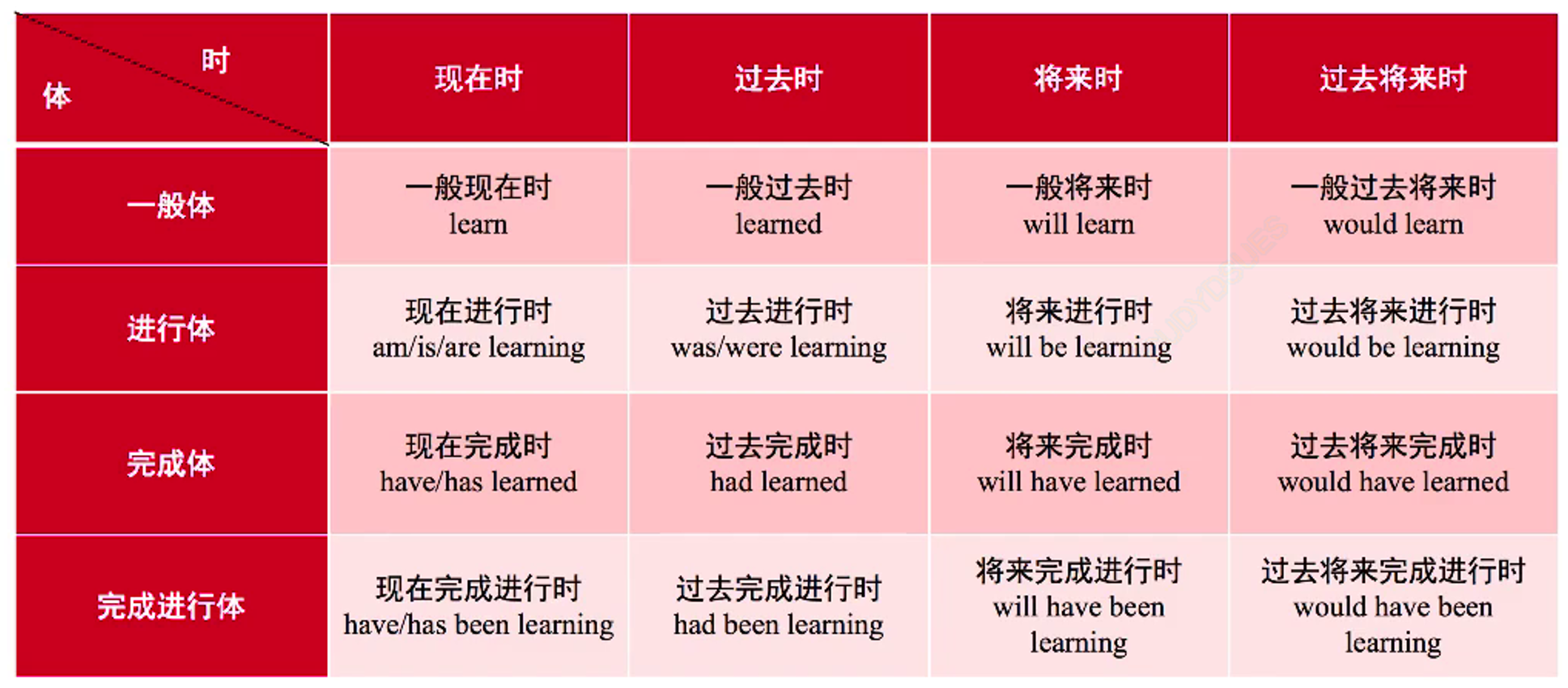
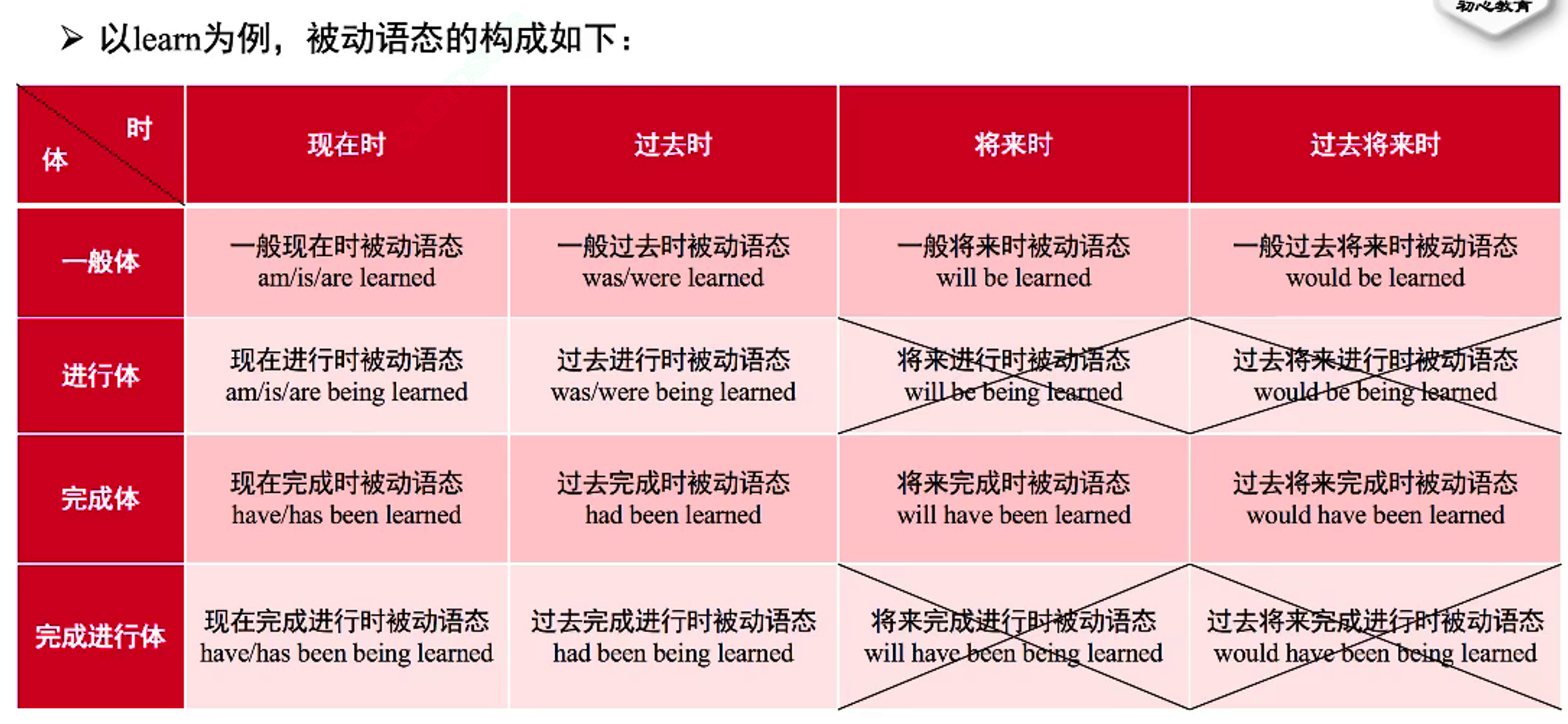
一般现在时
- 一般现在时,用于描述客观真理、自然现象、格言警句等。
- Light travels faster than sound.(光比声音传播快。)
- Stick to one job; a rolling stone gathers no moss.(坚守一份工作;滚石不生苔,转行不聚财。)
- 一般现在时,描述习惯性、恒常性的状态或动作。
- What does your father do, Cami?(凯米,你父亲做什么工作?)
- Every morning he goes to the market to buy fresh fruits and vegetables for his diet.(每天早上他去市场为他的饮食采购新鲜的果蔬。)
- 一般现在时,用于根据时间表拟定或安排的动作。
- The plane takes off at half past seven in the evening.(飞机晚上七点半起飞。)
- Our school bus begins at 6:00 in the morning, and continues until 4:00 in the afternoon.(我们的校车从早上6:00开始,一直持续到下午4:00。)
- 一般现在时,用于时间、条件等状语从句中代替将来时。(主将从现)
- The sports meeting will be postponed if it rains.(如果下雨,运动会将推迟。)
- When you start making an album, you’d better choose a few representative photos.(当你开始制作相册时,最好选择一些有代表性的照片。)
使用一般现代时翻译以下句子
- 一燕不成夏。
- One swallow doesn’t make a summer.
- 如果不下雨,我就去远足。
- If it doesn ‘t rain, I will go hiking.
- 他从不做家庭作业,但是每次都考第一。
- He never does homework but always comes first in the exams.
- 火车在十分钟后离开北京,晚上九点到达上海。
- The train leaves Beijing in ten minutes and arrives in Shanghai at nine in the evening.
一般过去时
- 一般过去时,描述过去的动作或状态。
- They sowed wheat by hand in the past and now they do it using machine.(过去他们手工播种小麦,现在他们用机器播种。)
- This beautiful town was once a famous tourist spot but now everything is gone.(这个美丽的小镇曾经是著名的旅游胜地,但现在一切都不复存在了。)
- 一般过去时,描述过去一连串具有先后性的动作。
- My mother gently walked to my bed, stroked my forehead, helped me up, and told me that everything would be all right soon.(妈妈轻轻地走到我的床边,抚摸我的额头,把我扶了起来,告诉我一切很快就会好的。)
- The child went to the blackboard, picked up the chalk, stood on tiptoe, and drew a mountain.(小朋友走到黑板前,拿起粉笔,踮起脚尖,画了一座山。)
- 一般过去时,用于在提建议时表示婉转的语气,用于want, think, hope,wonder等词。
- I thought we could have a drink before dinner.(我想我们可以在晚饭前喝一杯。)
- I wondered if you might want to see the concert with me this evening.(我想今晚你是不是可以和我一起看这场演唱会。)
- 一般过去时,用于表述与现在事实相反的主观设想。用于It’time(是时候…),I wish(我希望),I’d rather(我宁愿)等结构之后的从句中。
- I’d rather you bought a new house. 我宁愿你买一所新房子。
- It’s time you had a holiday to relax yourself. 是时候你该去度假放松一下自己了。
- I wish my daughter lived closer to me. 我希望女儿住得离我近些。
使用一般过去时翻译以下句子
- 是时候我们休息一下了。
- It’s time we had a rest.
- 上周五我们去了伦敦。
- We visited London last Friday.
- 我宁愿你立刻离开。
- I’d rather you left right away.
- 她起床、刷牙、洗脸,匆匆吃了早饭,就赶往学校了。
- She got up, brushed her teeth, washed her face, had a quick breakfast and rushed to school.
一般将来时
- will+do构成的一般将来时,表示将要发生的动作或状态。
- There will be a concert in our city next week.(我们城市下周有一场音乐会。)
- The manager will tell me the details of the project tomorrow.(经理明天将告诉我项目的具体事项。)
- am/is/are going to do 构成的一般将来时,表示已经安排好的、或有迹象要发生的事情。
- I am going to collect the data for my paper .(我打算为我的论文收集资料。)
- It is going to be a fantastic party tonight.(今晚(一定)将是一场非常棒的聚会。)
- am/is/are to do构成的一般将来时,用于必定会发生的、或表示职责、义务要求的事情。
- They are never to meet again.(他们注定以后不会再见面了。)
- The designer is to visit our company the day after tomorrow.(设计师后天要参观我们公司。)
- am/is/are about to do构成的一般将来时,表示客观上动作即将发生。
- The cherry blossom season is about to begin.(樱花季即将开始。)
- She is about to cry. Don’t annoy her anymore.(她快哭了。别再惹她了。)
- 现在进行时(am/is/are doing)表示一般将来时,主要用于位置移动的动词或部分动态动词,如go,come, leave,move, start,arrive, stay, run等。
- She is leaving for Thailand tonight.(她今晚出发去泰国。)
- Her fathcr is coming cither today or tomorrow.(她父亲不是今天就是明天来。)
- Peter and his family are moving to their new apartment tomorrow.(彼得和他的家人明天要搬去他们的新公寓。)
使用一般将来时翻译以下向子,注意根据语义选择合适的结构
- 他计划今晚复习英语。
- He is going to review English tonight.
- 快到吃李子的季节了。
- The plum season is about to begin.
- 她后天出发去束埔寨。
- She is leaving for Cambodia the day after tomorrow.
- 我知道我们注定会分开的。
- I know that we are to be apart.
一般过去将来时
与一般将来时的区别:
would+do构成的一般过去将来时,表示过去时间范围内将要发生的动作或状态。
was/were going to do构成的一般过去将来时,表示过去时间范围内已经安排好的、或有迹象要发生的事情。
was/were to do构成的一般过去将来时,用于过去时间范国内必定会发生的、或表示职责、义务要求的事情。
was/were about to do枸成的一般过去将来时,表示过去
时间范園内客观上动作即将发生。过去进行时(was/were doing)表示一般过去将来时。
一般过去将来时很多时候都用于宾语从句中,该类宾语从句又属于“间接引语”即引述别人说的话。
- My friend told me that there would be a concert in our city.(我的朋友告诉我,我们城市将有一场音乐会。)
- She said that she was going to collect the data for her paper.(她说她计划为她的论文收集资料。)
- They said goodbye in tears, knowing that they were never to meet again.(他们泪流满面地说再见,知道他们再也见不到了。)
- The teacher mentioned that the cherry blossom season was about to begin.(老师提到樱花季节即将到来。)
- Peter phoned me that he was moving to a new city the next day to start his new life.(彼得打电话给我说他第二天要搬到一个新城市开始他的新生活。)
使用一般过去将来时翻译以下句子
- 他说为了期末考试,他准备好好复习。
- He said he was going to review attentively for the final exam.
- 当时,老师告诉我们快到吃李子的季节了。
- At that time, the teacher told us that the plum season was about to begin.
- 她当时打电话告诉我,她第二天要出发去柬埔寨。
- She phoned me that she was leaving for Cambodia the next day.
- 他们挥手告别,知道彼此注定会分开。
- They waved goodbye, knowing that they were to be apart.
现在进行时
- 现在进行时,表示说话者正在说话时发生的动作。
- Look! He is now standing there and eating a Japanese rice ball.(看!他现在站在那里吃日本饭团。)
- What are you doing? - I‘m packing the present for my father tomorrow.(你在干什么?-我在包装明天给父亲的礼物。)
- 现在进行时,表示目前阶段内一直进行着的动作。
- The author is currently working on his new novel.(这个作者目前正在写他的新小说。)
- I used to teach in college but now I am working as a high school researcher.(我以前在大学教书,但目前我是一名高中教研员。)
- 现在进行时,表示说话者正在说话时某个动作的不断重复。此类动词限于瞬间性动作,如jump, wink,nod等等。
- I don’t know why he is winking at me.(我不知道他为什么不停对我眨眼。)
- This quiet girl is jumping with great joy at the sight of her mother’s arrival.(看到母亲的到来,这个安静的女孩高兴得跳个不停。)
- 现在进行时,与频度副词连用表达说话者的惑情色彩。
- He braes albout how clever he is.(说明事实:他吹嘘自己有多聪明。)
- He is continuously bragging about how clever he is.(表达不满:他不断吹嘘自己有多聪明。)
- She complains about her tcacher.(说明事实:她抱怨她的老师。)
- She is always complaining about her teacher(表达不满:她总是抱怨她的老师。)
使用现在进行时翻译以下句子
- 我父亲总是吸雪茄。
- My father is always smoking cigars.
- 他正不停地点头以示同意。
- He is nodding to show his agreement.
- 听!是谁在唱歌?
- Listen! Who is singing?
- 我目前正在写我的毕业论文。
- I am currently working on my graduation thesis.
过去进行时
与现在进行时的比较
过去进行时,表示过去某一时刻说话者正在说话时发生的动作。
过去进行时,表示过去某一阶段内一直进行着的动作。
过去进行时,表示过去某一时刻说话者正在说话时某个动作的不断重复。
过去进行时,与频度副词连用,表示说话者对过去时间范围内发生的动作的感情色彩。
过去进行时表示一般过去将来时。
At that time, he was standing there and eating a Japanese rice ball.(那个时候,他正站在那里吃日本饭团。)
From 1993 to 2008, I was teaching in college.(1993年至2008年,我一直在大学教书。)
This quiet girl was jumping with great joy when she noticed her mother’’s arrival.(当注意到她母亲的到来时,这个安静的女孩高兴得跳个不停。)
There was a time when he was continuously bragging about how clever he was.(曾经有一段时间他不断地吹嘘自己有多聪明。)
使用过去进行时翻译以下句子
- 曾经有一段时间我父亲总是吸雪茄。
- There was a time when my father was always smoking cigars.
- 那个时候,他正不停地点头以示同意。
- At that time, he was nodding to show his agreement.
- 昨晚七点的时候,Lucy正在唱歌。
- Lucy was singing at seven o’clock last night.
- 去年10月至12月期间,我一直在写毕业论文。
- I was working on my graduation thesis from October to December last year.
将来进行时
- 将来进行时,表示将来某一特定的时刻正在进行的动作。
- We will be having a meeting at 8 o’clock tomorrow morning.(我们明天早上8点正在开会。)
- What will you be doing this time tomorrow afternoon?(明天下午这个时候你正在做什么?)
- 将来进行时,表示将来某个阶段内一直持续的动作。
- I will be working in Paris from Saturday to Sunday next week.(下周的星期六至星期日,我将一直在巴黎工作。)
- Miss Shen will be teaching Chinese at the Confucius Institute in Italy next year.(沈老师明年将一直在意大利孔子学院教授汉语。)
- 将来进行时,用于委婉地询问他人的计划或安排。
- When will we be meeting again?(我们什么时候再见面?)
- Will you be passing by the post office when you are out?(你出去时会经过邮局吗?)
- 将来进行时与一般将来时的区别。一般将来时会含有一种主观上的“意愿”色彩,但将来进行时是纯粹地客观描述或提问将来的动作。
- Will you perform tonight? (含有主观意愿:你愿意今晚演出吗?)
- Will you be performing tonight?(纯粹客观提问:你今晚有演出吗?)
- He won’t send an email to her tonight.(含有主观意愿:他今晚不愿发邮件给她。)
- He won’t be sending an email to her tonight(纯粹客观描述:他今晚不会发邮件给她。)
使用将来进行时翻译以下句子
- 下星期天这个时候,我正在东南亚度假。
- This time next Sunday, I will be having my holiday in Southeast Asia.
- 明天一整个下午,我将一直在听讲座。
- I will be listening to the lecture all afternoon tomorrow.
- 你去日本的时候会经过免税店吗?
- Will you be passing the duty-free shops when you go to Japan?
- 今天下午他将亲自写信表示谢意。
- He will be writing a letter in person this afternoon to show his gratitude.
现在完成时
- 现在完成时,表示过去发生的动作或状态对现在的影响。注意和一般过去时作好对比,一般过去时只是单纯描述某个动作或状态在过去发生。
- I finished my homework.(一般过去时:单纯描述“过去某个时间我做完了作业”这个动作。)
- I have finished my homework.(现在完成时:描述作业在过去某个时间做完了,而且现在作业仍1旧处于做完”的状态。〕
- All the participants left three minuts ago.(一般过去时:单纯描述三分钟前所有的参赛者全部离开了。)
- All the participants have left since three minuts ago.(现在完成时:描述w所有的参舞者在三分钟之前已经全部离开,且现在是毫无一人”的状态。)
- 现在完成时,表示过去发生的动作或状态一直持续到现在。
- I have lived here since I moved here in 2008.(我从2008年搬到这里之后,就一直住在这里。)
- Since the mysterious disappearance of the ship, there have been no new clues at all.(自从船只神秘消失以来,至今毫无任何新的线索。)
- 现在完成时,表示已经经历过的事情。
- Have you ever been to Europe before?(你曾经去过欧洲吗?)
- I am so fond of the exhibition that I have been there three times.(我太喜欢这个展览了,已经去过三次了。)
- How many times have you been discouraged by the unexpected hardships?(你有多少次曾因为意料之外的困难而气馁?)
- 现在完成时,用于It is/will be the first time that句型及其类似的句型中。
- It is the first time that I have broken the vase.(这是我第一次打碎花瓶。)
- It is the tenth time that he has been praised.(这是他第十次受到表扬。)
- This will be my second time that I have performed my favourite Beijing Opera on stage.(这将是我第二次在舞台上表演我最喜欢的京剧。)
- This evening will be my third time that I have been invited to an academic seminar.(今晚将是我第三次被邀请参加学术研讨会。)
使用现在完成时翻译以下句子
- 今天将是我第一次出席一场正式聚会。
- Today will be the first time that I have attended a formal party.
- 你曾经看过那个有趣的 《PPAP》 音乐短片吗?
- Have you ever seen that interesting PPAP music video?
- 自从我母亲来后,我一直受到很好的照顾。
- I have been well taken care of since my mother came.
- 我已经有差不多两三年没见到他了。
- I haven’t seen him for almost two or three years.